
What’s Covered in Your California Home Insurance?
When you buy a home insurance policy in California, you’re usually thinking about the big stuff: the house itself, the roof, the walls. That’s your dwelling coverage. But what about everything *inside* those walls? All the things that make a house a home? That’s where personal property coverage comes in. It’s a key part of your standard HO-3 homeowner’s policy, designed to protect your belongings from a list of specific disasters. It’s not just about the structure; it’s about your life’s accumulation.
The Basics: What “Personal Property” Really Means
Think of personal property as almost anything you’d take with you if you moved – furniture, clothes, electronics, kitchen gadgets, books, even your toothbrush. It’s all the stuff that isn’t permanently attached to the house. Your policy typically covers these items whether they’re sitting in your living room in San Diego, packed away in your garage in the Inland Empire, or even if you take them with you on vacation to Hawaii.
Most policies set your personal property coverage as a percentage of your dwelling coverage. So, if your house is insured for $500,000, your personal property might be covered for $250,000 to $350,000 – usually 50% to 70%. That sounds like a lot, doesn’t it? But when you start adding up everything you own, from that old couch to your kids’ gaming consoles, it can get surprisingly high.

Actual Cash Value vs. Replacement Cost Value: A Big Difference
Here’s where it gets interesting. When you file a claim for your personal property, your insurer will pay out based on one of two methods: Actual Cash Value (ACV) or Replacement Cost Value (RCV). This isn’t just a technical detail; it’s a huge factor in how much money you actually get after a loss.
Actual Cash Value pays you what your item was worth *at the time of the loss*, minus depreciation. Think of it like this: if your five-year-old TV gets stolen, the insurer doesn’t pay you what a brand-new TV costs today. They pay you what a five-year-old TV in similar condition would sell for on the used market.
Replacement Cost Value, on the other hand, pays you the cost to replace your damaged or stolen item with a brand-new one of similar quality and kind. No depreciation taken out. If that five-year-old TV gets stolen, you get enough money to buy a new TV.
Why ACV Can Leave You Short
Honestly, most people want Replacement Cost Value. It just makes more sense. Imagine losing everything in a house fire in the Valley. If your policy is ACV, you’re trying to rebuild your entire life with money that only covers the depreciated value of your old belongings. That old sofa? It might fetch $50 at a garage sale. But a new one costs $1,000. That’s a big gap.
Many homeowners don’t realize their policy defaults to ACV for personal property until it’s too late. It’s a cheaper option, sure, but the savings upfront can lead to serious financial pain later. Always check your policy declarations page to see which type of coverage you have for your personal property. If it’s ACV, seriously consider upgrading to RCV. It’s a smart move, especially in a state like California where total losses from wildfires or other disasters aren’t just hypothetical.
Common Perils Covered (and What’s Not)
Standard personal property coverage protects your stuff from a list of “named perils.” These usually include things like fire, smoke, theft, vandalism, damage from falling objects, and certain types of water damage – like a burst pipe or a sudden overflow from an appliance.
But wait — not everything is covered. Earthquakes? Nope. That’s a separate policy you need to buy, often from the California Earthquake Authority (CEA). Floods? Also a separate policy, usually through the National Flood Insurance Program. Mudslides? Often excluded unless directly caused by a covered peril, which can get complicated in places like Malibu or the Santa Cruz mountains after heavy rains.
Wildfire Woes and Your Stuff
California homeowners know the wildfire risk all too well. From the massive fires in Paradise to the recent blazes near Lake Tahoe or in Ventura County, these events are devastating. Your personal property coverage is absolutely critical in a wildfire scenario. If your home is a total loss, you’re not just replacing the structure; you’re replacing every single item inside it.
Thinking about the sheer volume of things you own, and then trying to list them all from memory after a traumatic event? It’s almost impossible. This is why having enough RCV coverage for your personal property is so important in California. You don’t want to be fighting with your insurer over the depreciated value of your childhood photo albums or your kitchen appliances when you’re trying to rebuild your life.
Special Limits: When Your Policy Says “Not So Fast”
Even with Replacement Cost Value coverage, there are limits. Many policies have “special limits” or “sub-limits” for certain types of high-value personal property. These aren’t the overall coverage amount; they’re caps on how much the insurer will pay for *specific categories* of items, regardless of their actual value.
For example, a typical policy might only pay $1,500 for all your jewelry combined if it’s stolen. Or $2,500 for firearms. Cash? Maybe only $200. Artwork, furs, collectibles, silverware – these often have their own low limits.
This can be a rude awakening for someone who loses an engagement ring worth $10,000 or a coin collection valued at $5,000. Your policy might cover the couch, but it won’t cover the full value of those special items.
Scheduling Personal Property: Your High-Value Solution
So, what do you do if you own expensive jewelry, fine art, a vintage guitar collection, or rare stamps? You “schedule” them. This means adding a “personal articles floater” or endorsement to your policy.
When you schedule an item, you typically get an appraisal for it, and the insurer agrees to cover it for that specific amount. The coverage is often “all-risk,” meaning it’s protected from almost any type of loss, not just the named perils in your standard policy. It even covers “mysterious disappearance” – like if your ring simply vanishes. It’s a separate premium, but for truly valuable items, it’s the only way to ensure they’re fully protected.
The Inventory: Your Best Friend After a Loss
Let’s be blunt: if you don’t have a home inventory, you’re making a huge mistake. After a fire or a major theft, trying to remember every single item you owned is incredibly difficult. Most people underestimate how much stuff they have.
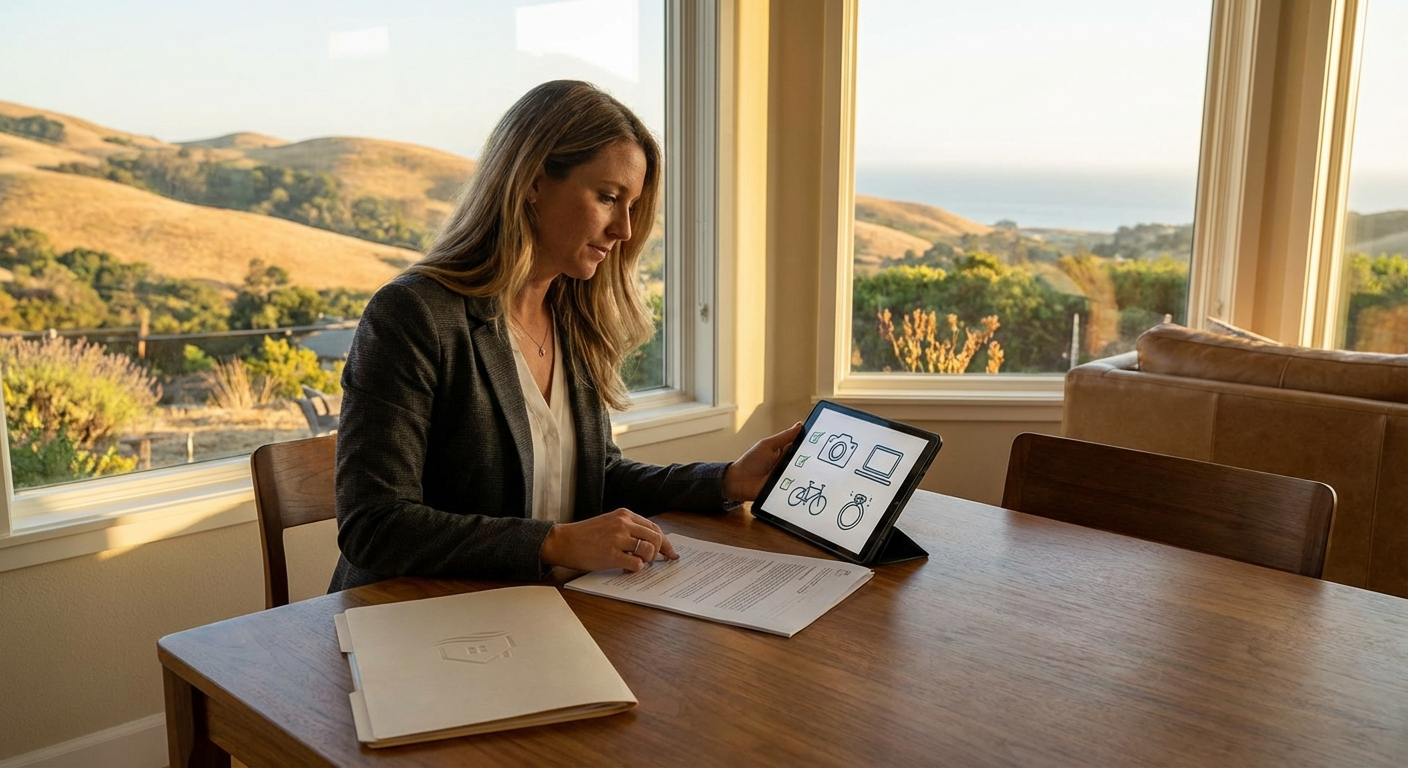
An inventory is simply a detailed list of your belongings. Take photos. Shoot a video walking through your house, opening drawers and closets. List brand names, model numbers, and approximate purchase dates. Keep receipts for big-ticket items.
This isn’t just busywork. A good inventory speeds up the claims process significantly. It proves you owned the items, helps establish their value, and ensures you don’t forget anything important. Store this inventory off-site – in the cloud, on an external hard drive at a friend’s house, or in a safe deposit box. Don’t keep it in the house you’re insuring!
California’s Shifting Sands: What’s Happening with Home Insurance
California’s home insurance market is, to put it mildly, challenging right now. Insurers like State Farm, Farmers, and AAA have either paused new policies or significantly tightened their underwriting guidelines. Premiums for existing policies have jumped, with some homeowners seeing increases of 40% or more between 2022 and 2024, especially in higher-risk areas.
The reasons are complex: rising wildfire risks, soaring reconstruction costs, and the state’s regulatory environment (Prop 103, which gives the Insurance Commissioner power over rate approvals). This situation often leaves homeowners with fewer choices and higher prices. Many are forced onto the FAIR Plan – California’s “insurer of last resort” – which provides basic coverage but is typically more expensive and less comprehensive than a standard policy.
Why an Independent Agent Matters More Than Ever
In this environment, finding the right personal property coverage, and indeed the right home insurance overall, is tougher than ever. That’s why working with an experienced independent agent is so important. Someone like Karl Susman of California Home Insurance Rates, CA License #0B75129, doesn’t just work with one company. He can shop around with multiple carriers, including those still writing policies in California, to find you the best possible coverage and rates.
They understand the nuances of the California market – the specific perils, the regulatory hurdles, and which insurers are still offering competitive options. It’s not about just getting *any* policy; it’s about getting the *right* policy for your specific needs, protecting everything you own.
If you’re feeling lost in the California insurance maze, talking to a seasoned pro can make all the difference. Get a quote and see your options today: Get Your California Home Insurance Quote
Don’t Guess, Get Covered Right
Your personal property might seem like a secondary concern compared to the house itself, but it represents years of memories, hard work, and comfort. Losing it all, or realizing you don’t have enough coverage to replace it, is a devastating experience. Don’t let that happen to you.
Take the time to understand your personal property coverage. Know whether you have Actual Cash Value or Replacement Cost Value. Be aware of those special limits for high-value items. Make that home inventory. Review your policy regularly, especially if you’ve made significant purchases or home improvements.
Ready to make sure your belongings are truly protected? Don’t wait until it’s too late. Reach out to Karl Susman and his team at California Home Insurance Rates, CA License #0B75129, or click here to start the process: Start Your Quote Now. You can also call us directly at (877) 411-5200.
Frequently Asked Questions About Personal Property Coverage
Does my personal property coverage extend outside my home?
Yes, typically it does. Most standard policies offer some coverage for your personal belongings even when they’re not on your property. This might apply if your laptop is stolen from a coffee shop, or your luggage goes missing while you’re traveling. However, there are usually limits to this “off-premises” coverage, often a percentage of your total personal property limit.
What if I have a home-based business? Is my equipment covered?
Generally, a standard homeowner’s policy offers very limited coverage for business property. There’s often a small sub-limit (e.g., $2,500) for business equipment on your premises, and even less for off-premises. If you run a business from home, you’ll likely need a separate business insurance policy or a specific endorsement added to your home policy to adequately cover your business assets.
Can I get personal property coverage without dwelling coverage?
Not usually with a standard homeowner’s policy. Personal property coverage is typically part of a broader HO-3 policy that also covers the dwelling. If you’re a renter, you’d get a renter’s insurance policy (HO-4), which primarily covers your personal property and liability, since you don’t own the dwelling.
How much personal property coverage do I really need?
The best way to determine this is to create a detailed home inventory. Go room by room and list everything you own, estimating its replacement cost. Once you have that total, you’ll have a much clearer idea of how much coverage you need. Don’t forget to factor in items with special limits, and consider scheduling those separately.
Will my policy cover items stored in a self-storage unit?
Most homeowner’s policies offer some coverage for personal property stored in a self-storage unit, but it’s often limited. The coverage amount might be a smaller percentage of your total personal property limit (e.g., 10%) or have a specific dollar cap. If you have valuable items in storage, it’s wise to check your policy’s specifics or consider purchasing separate storage unit insurance.
This article is for informational purposes only and does not constitute financial advice.